Have a look at the following presentations to revise the use of the present perfect tense.
Mostrando entradas con la etiqueta 4º ESO. Mostrar todas las entradas
Mostrando entradas con la etiqueta 4º ESO. Mostrar todas las entradas
lunes, 30 de septiembre de 2019

miércoles, 11 de septiembre de 2019
NEW ACADEMIC YEAR 2019/2020
 New academic year, new challenges. This year I will be teaching 4º ESO level and 1º Bachillerato.
I hope ,you, my students will be ready for this forhcoming adventure and will find this blog useful.
New academic year, new challenges. This year I will be teaching 4º ESO level and 1º Bachillerato.
I hope ,you, my students will be ready for this forhcoming adventure and will find this blog useful. I will be using it as a tool to share ideas and resources to help you improve your English. So, WELCOME TO MY BLOG!!!!
lunes, 29 de mayo de 2017
GERUNDS AND INFINITIVES
You can watch the following video to revise the uses of Gerunds and Infinitives.
Finally, here is a video with some songs lyrics showing the use of gerunds and infinitives.
Finally, here is a video with some songs lyrics showing the use of gerunds and infinitives.
domingo, 28 de mayo de 2017
KET AND PET EXAM PRACTICE
Here are some websites you can look at for your KET and PET for schools speaking practice before the exam date which will be on Friday 2nd June 2017:
Remember: the Speaking section is worth 25% of the total score for the exam
KET:
http://www.cambridgeenglish.org/exams/key-for-schools/
http://www.englishaula.com/en/ket-exam-speaking-cambridge-key-english-test-video-lessons-practice-tests-exercises.php
/vlec.es/tutoriales/#keyfs
http://www.english-online.org.uk/ketfolder/ktest1.php?name=Practice%20for%20the%20Key%20English%20Test%201
quizlet.com/21710498/flashcards
Speaking test sample:
PET:
http://www.cambridgeenglish.org/exams/preliminary-for-schools/
vlec.es/tutoriales/#petfs
http://www.englishaula.com/en/pet-exam-speaking-cambridge-preliminary-english-test-video-lessons-practice-tests-exercises.
http://www.flo-joe.co.uk/preliminaryenglish/pet-speaking-practice-tests.htm
Speaking test sample:
Remember: the Speaking section is worth 25% of the total score for the exam
KET:
http://www.cambridgeenglish.org/exams/key-for-schools/
http://www.englishaula.com/en/ket-exam-speaking-cambridge-key-english-test-video-lessons-practice-tests-exercises.php
/vlec.es/tutoriales/#keyfs
http://www.english-online.org.uk/ketfolder/ktest1.php?name=Practice%20for%20the%20Key%20English%20Test%201
quizlet.com/21710498/flashcards
Speaking test sample:
PET:
http://www.cambridgeenglish.org/exams/preliminary-for-schools/
vlec.es/tutoriales/#petfs
http://www.englishaula.com/en/pet-exam-speaking-cambridge-preliminary-english-test-video-lessons-practice-tests-exercises.
http://www.flo-joe.co.uk/preliminaryenglish/pet-speaking-practice-tests.htm
Speaking test sample:
domingo, 23 de abril de 2017
REPORTED SPEECH: KIDS SAY THE FUNNIEST THINGS
Practise using the reported speech with this fun video activity. Listen to what the children say and then change their direct speech into reported speech:
HAPPY SAINT GEORGE´S DAY !!!


El día 23 de abril, fecha del Día de San Jorge, fue el elegido para conmemorar la muerte de este popular santo guerrero cuando fue canonizado en el año 494. Las leyendas sobre su vida son muy numerosas pero la más célebre, sin duda, es la que relata su lucha con el dragón que atemorizaba y diezmaba la población de una lejana ciudad. Esta lucha y la muerte de la bestia fabulosa a manos del santo es un tema recurrente de la literatura medieval occidental y uno de los motivos más representados de la historia del arte, desde la Edad Media hasta nuestros días.
La gran popularidad de este santo lo ha llevado a ser nombrado patrón incluso de países enteros como Inglaterra. Pero es en los países del sur de Europa y especialmente en España donde la fiesta del Día de San Jorge se celebra con especial devoción. Este día corresponde al día de la Comunidad Autónoma de Aragón, de la que san Jorge es patrón junto con las de Cataluña e Islas Baleares. Es precisamente en Cataluña donde podemos encontrar la que quizá sea la tradición festiva más arraigada de las relacionadas con este día, a pesar de no ser día de fiesta oficial en dicha comunidad autónoma.
En el día de Sant Jordi, los catalanes tienen la costumbre de obsequiar, a sus parejas o a las personas más allegadas, con rosas y libros; esta costumbre se ha convertido ya en tradicional e incluso ha comenzado a trasladarse a otras regiones españolas.El Día de San Jorge en 2015 se celebra el miércoles siguiente al lunes de Pascua y, como todos los años desde 1996, coincide con la conmemoración del Día Internacional del Libro, acontecimiento que suele llenar las plazas y paseos españoles con puestos de venta de libros al aire libre.
Para más información sobre "Saint George ", patrón de Inglaterra y su historia puedes ver el siguiente enlace.
Fuente El Northen
ACTIVIDADES PARA REALIZAR CON LOS ALUMNOS
La Editorial Macmillan, propone unas actividades para practicar con los alumnos en clase para que aprendan sobre la historia de este Santo. La actividad que adjunto fomenta el trabajo cooperativo y la creatividad. Es para alumnos de 4º ESO y 1º De Bachillerato. Os envío un enlace a esos ejercicios.
Fuente Macmillan: https://www.dropbox.com/s/vfiwt9b6csuor12/%20Saint%20George%20LIFE%20SKILLS.pdf?dl=0
Feliz día!. Have a great day!
domingo, 26 de febrero de 2017
PASSIVE VOICE
Today we are explaining the differences between the active and passive voice.
Look at the following links to practise the passive :
Passive voice exercises
Passive voice exercises: advanced level
Look at the following links to practise the passive :
Passive voice exercises
Passive voice exercises: advanced level
jueves, 26 de enero de 2017
martes, 17 de enero de 2017
COLLOQUIAL FORMS IN SONGS
Colloquial language can be defined as informal spoken language.
Today we are learning to identify and use the colloquial contractions “wanna, gotta, and gonna.”and other informal words you can hear in some modern songs. You should definitely not use them in formal written English (reports, research papers, formal e-mails, etc), in which case, you need to spell them out in long form. But learning to use them correctly in your speaking and writing will make your communication much more effective.
Here is a short video that shows some colloquial forms in different songs:
As an extention activity, you can do more exercises about English informal language in the following link: English informal language
Today we are learning to identify and use the colloquial contractions “wanna, gotta, and gonna.”and other informal words you can hear in some modern songs. You should definitely not use them in formal written English (reports, research papers, formal e-mails, etc), in which case, you need to spell them out in long form. But learning to use them correctly in your speaking and writing will make your communication much more effective.
Here is a short video that shows some colloquial forms in different songs:
As an extention activity, you can do more exercises about English informal language in the following link: English informal language
lunes, 9 de enero de 2017
10 INVENTIONS QUIZ
As an extention activity, you are about to see a video about 10 inventions which will make your life easier. Watch the video and answer the questions proposed in the following link: 10 Inventions Quiz
Which one do you like the most? Why?.
Which one do you like the most? Why?.
NEW YEAR´S RESOLUTIONS
We are starting the year with some new resolutions.
Watch this video clip and answer the questions based on what you see and hear. This is the link to the activity: New year´s resolutions.
Watch this video clip and answer the questions based on what you see and hear. This is the link to the activity: New year´s resolutions.
martes, 20 de diciembre de 2016
CHRISTMAS ACTIVITIES
The short video you are about to watch is about the origins of Christmas.
Answer the following reading comprehension questions you will find in this link:
Origins of Christmas
Then, we can watch a video called Mog´s Christmas calamities and you can work with the activities suggested in this link:
http://film-english.com/2015/12/18/mogs-christmas-calamity/
Answer the following reading comprehension questions you will find in this link:
Origins of Christmas
Then, we can watch a video called Mog´s Christmas calamities and you can work with the activities suggested in this link:
http://film-english.com/2015/12/18/mogs-christmas-calamity/
jueves, 24 de noviembre de 2016
HAPPY THANKSGIVING
 Today is Thanksgiving day and our American language assistant has done a presentation about it.
Some students have asked to see it again to revise vocabulary and grammar issues. So, here is her lesson for thanksgiving. First is a video explaining the history of Thanksgiving: click on this link
Then, a powerpoint about food items eaten at Thanksgiving:
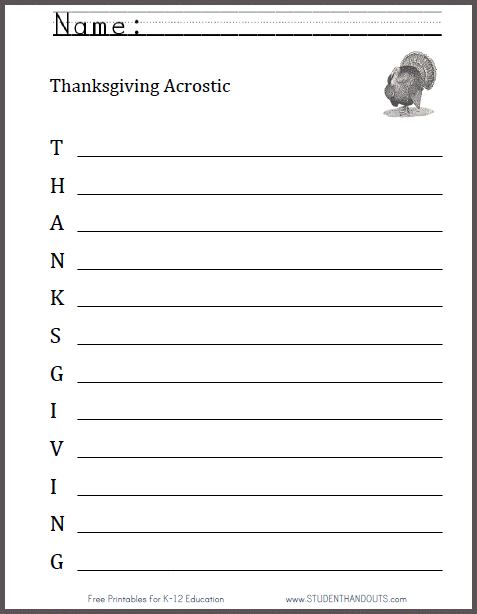
Lastly for a writing activity they have completed this Thanksgiving poem "Thanksgiving Acrostic poem":
lunes, 21 de noviembre de 2016
PAST PERFECT SIMPLE
You are about to watch two short videos explaing the past perfect simple tense.
After that, you can revise and do the exercises proposed in the following links:
Past perfect simple revision and exercises (level I )
Past perfect simple extention exercises (level II )
After that, you can revise and do the exercises proposed in the following links:
Past perfect simple revision and exercises (level I )
Past perfect simple extention exercises (level II )
jueves, 3 de noviembre de 2016
martes, 25 de octubre de 2016
THE HISTORY OF HALLOWEEN
Today, we have seen the following video to talk about Halloween.
For further information about Halloween origins, traditions, superstitions... I recommend seeing this link:
History of Halloween
For further information about Halloween origins, traditions, superstitions... I recommend seeing this link:
History of Halloween
jueves, 20 de octubre de 2016
VOCABULARY– WEATHER, CLIMATE AND NATURAL DISASTERS · engVid
Vocabulary – Weather, climate, and natural disasters · engVid: Worried about natural disasters like hurricanes, earthquakes, and tsunamis? When we make small talk in English, we often talk about the weather and recent natural events on our planet. In this lesson, Ill teach you English vocabulary to talk about weather, climate, and natural disasters. Watch this lesson, and youll learn how to follow climate news, how to discuss weather trends, and much more. Take the quiz to test your understanding! When youre done, practice by posting a comment about a natural disaster in your country.
miércoles, 19 de octubre de 2016
CREATIVE WRITING
Following the class we had with Julie, our language assistant this year, here is her presentation about creative writing. I hope you will find it useful to write your diary entry.
REMEMBER:
First, you have to hand in your writing on Friday 21st October.
click on the following link for the: Writing guidelines
Secondly, I also remind you of the date for your next English test: On 28th October .
The exam will include Unit 1 and part of Unit 2.
REMEMBER:
First, you have to hand in your writing on Friday 21st October.
click on the following link for the: Writing guidelines
Secondly, I also remind you of the date for your next English test: On 28th October .
The exam will include Unit 1 and part of Unit 2.
viernes, 7 de octubre de 2016
PRESENT PERFECT VS PAST SIMPLE
I am revising the present perfect and past simple tenses in English with my 4º ESO students and I have found a useful powepoint presentation that will complement their knowledge about this subject. I also include a link to on line exercises as an extra practice. Hope you, my students, will find it useful. Let me know.
present perfect vs past simple exercises
present perfect vs past simple exercises
lunes, 19 de septiembre de 2016
CLASSROOM RULES
We are starting a new academic year!!! Time goes by so quickly...
This year, I will be teaching students from ESO.
Here are the classroom rules we have agreed to follow in our lessons:
This year, I will be teaching students from ESO.
Here are the classroom rules we have agreed to follow in our lessons:
Suscribirse a:
Entradas (Atom)